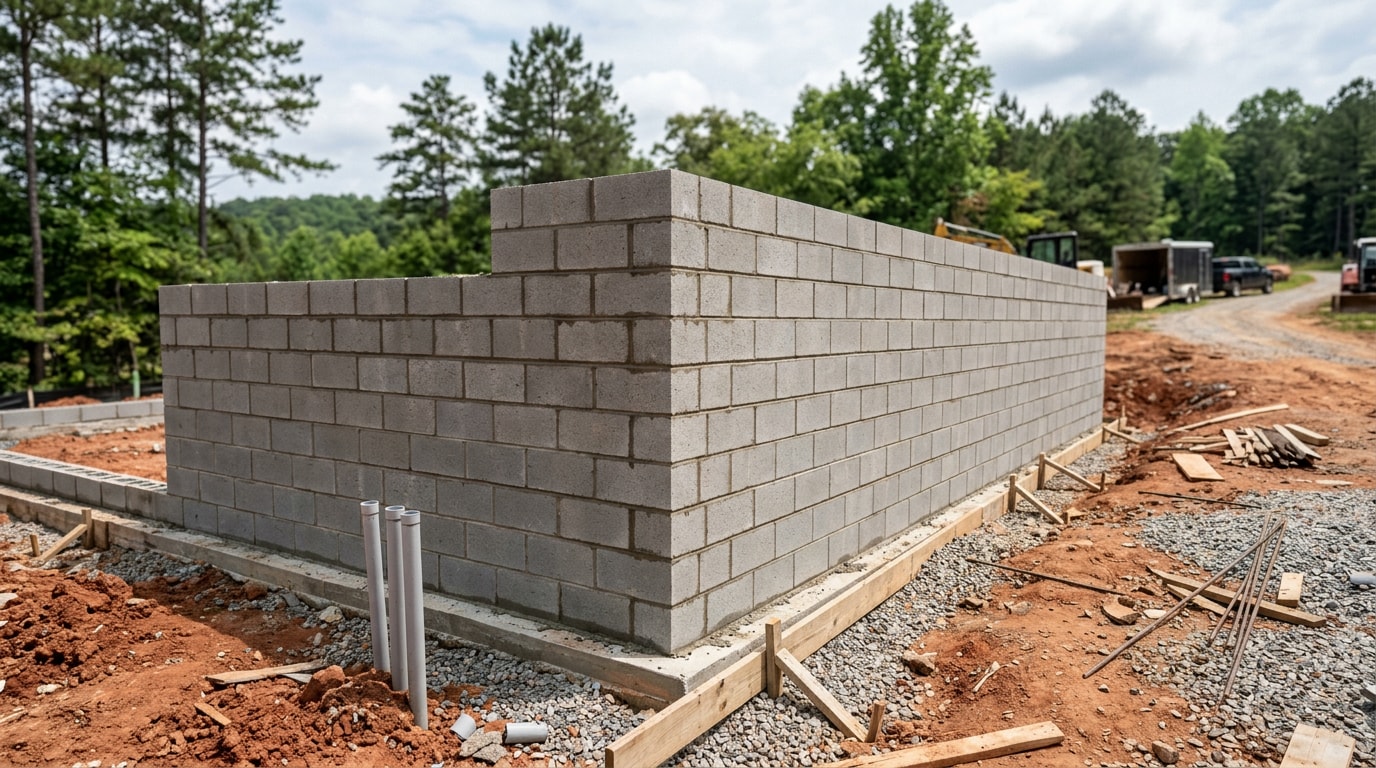
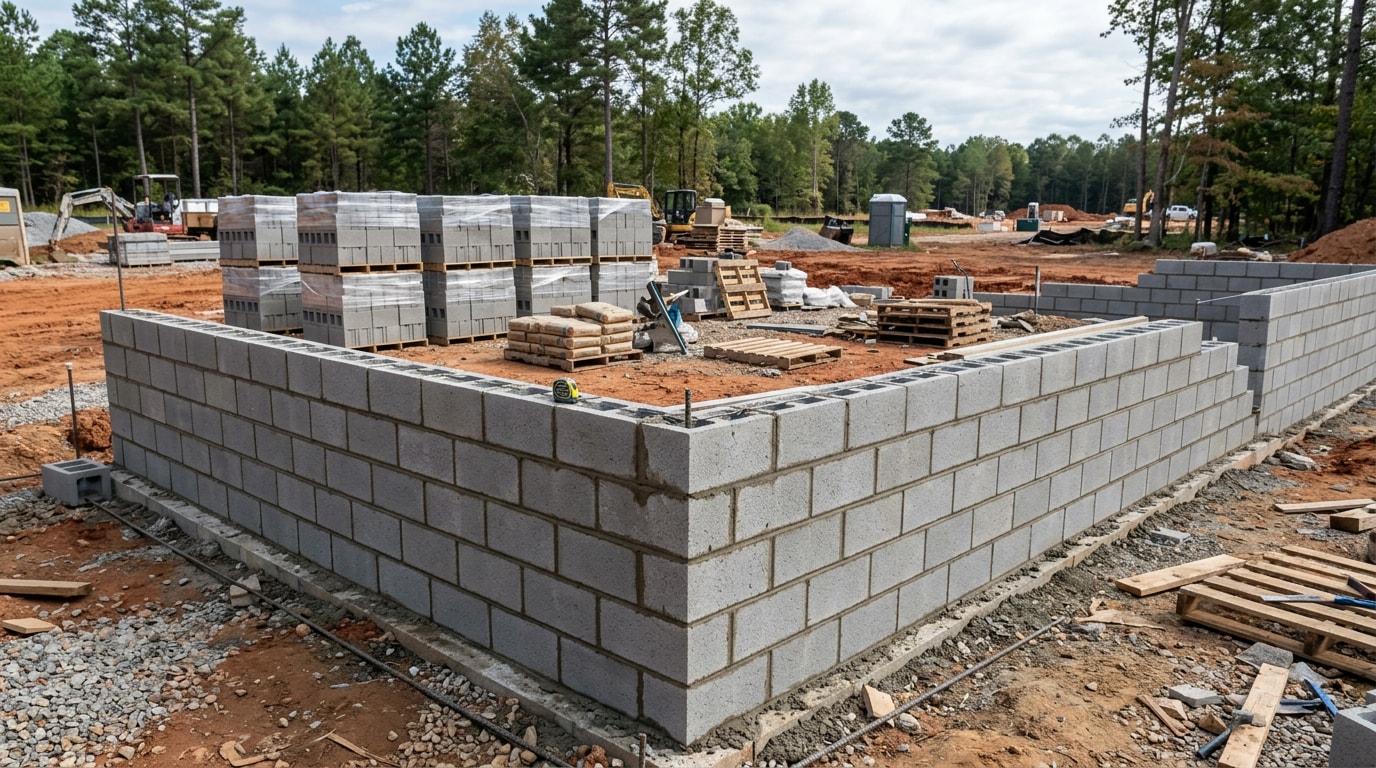
A CMU concrete masonry unit in Graham, NC is the block behind most foundations, retaining walls, and commercial storefronts going up across Alamance County right now. Homeowners and even some junior contractors still mix up "CMU," "cinder block," and "cement block" like they're the same product with three names. They're not quite, and getting the terminology and sizing right before you order material saves real money on a job site.
This guide breaks down what CMU actually is, how it's sized, what it costs in 2026, and where local code requirements come into play in Graham and the surrounding Piedmont Triad.
What Is a CMU (Concrete Masonry Unit)?
A CMU is a rectangular block made from cast concrete, used to build walls, foundations, and partitions. It's often called a "concrete block" or informally a "cinder block," even though those names technically describe slightly different products.
In Graham and across the Piedmont Triad, CMU is the standard choice for everything from house foundations to commercial storefronts. It's affordable, strong, and stocked by regional suppliers without special order lead times.
What Is a CMU Block Made Of?
A CMU block is made from a mixture of Portland cement, water, and aggregate such as sand, gravel, or crushed stone, poured into molds and cured under controlled conditions. Manufacturers sometimes add pigment for color or shift the aggregate blend to change weight and strength.
Standard CMU production follows ASTM C90 specifications for strength and dimensional consistency. Under that standard, units are split into three density classes, which matters more than most spec sheets let on:
| Density Class | Oven-Dry Weight | Typical Use Case |
|---|---|---|
| Lightweight | Less than 105 lb/ft³ | Upper-floor walls, weight-sensitive builds |
| Medium Weight | 105 to less than 125 lb/ft³ | Most residential and light commercial walls |
| Normal Weight | 125 lb/ft³ or more | Below-grade, heavy load-bearing applications |
The Concrete Masonry & Hardscapes Association notes that ASTM C90 units carry a minimum net area compressive strength of 2,000 psi, regardless of weight class. A standard 8x8x16 block typically weighs somewhere around 28 to 35 pounds depending on which class it falls into, which is worth knowing before you plan how many pallets your crew needs to move by hand.
CMU Sizes, Shapes & Dimensions
CMU comes in a range of widths, and understanding the difference between nominal and actual measurements matters when you're ordering materials or reading a set of plans. The most common widths you'll see locally are 4", 6", 8", and 12", each suited to a different structural role.
Here's how nominal sizing compares to actual dimensions across the full range:
| Nominal Width | Actual Width | Typical Use |
|---|---|---|
| 4" | 3 5/8" | Veneer, non-load-bearing facing |
| 6" | 5 5/8" | Partition walls, light framing backup |
| 8" | 7 5/8" | Standard load-bearing walls, foundations |
| 10" | 9 5/8" | Heavier load-bearing or fire-rated walls |
| 12" | 11 5/8" | Retaining walls, high-load structures |
Most NC-area producers stock the 6", 8", and 12" widths as standard inventory. The 4" and 10" sizes are often available by special order only, so plan ahead if your spec calls for them.
Common Nominal CMU Sizes
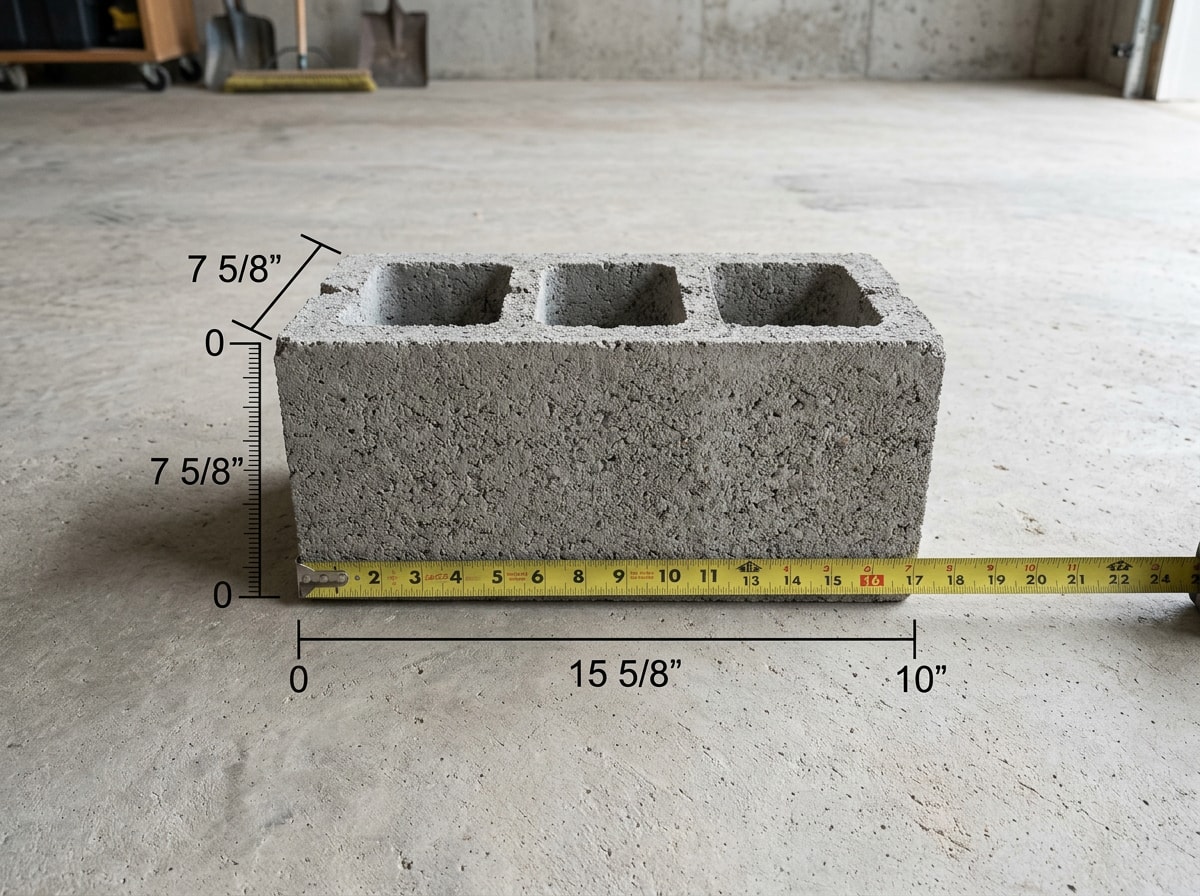
The most widely used nominal CMU size is 8x8x16: 8 inches high, 8 inches deep, and 16 inches long before mortar joints are factored in.
- Narrower 4" and 6" blocks typically go into veneer or interior partition walls.
- 8" and 12" blocks handle load-bearing and foundation work.
- Choosing the right width depends on the wall's structural role and local code requirements, not just what's cheapest at the yard.
Actual CMU Block Dimensions in Inches
The actual CMU dimensions are always 3/8 inch smaller than the nominal size in each direction, accounting for a standard mortar joint. That's why an 8x8x16 nominal block measures roughly 7 5/8 x 7 5/8 x 15 5/8 inches in reality. This deduction keeps modular wall dimensions consistent once blocks are mortared together.
CMU Block Shapes
Beyond standard rectangular units, CMU shapes vary based on where they sit in a wall assembly:
- Stretcher block – the most common shape, used for the bulk of a standard wall run
- Corner block – has one finished end for clean wall terminations
- Lintel block – creates a channel for horizontal reinforcement over openings like windows and doors
Mixing these shapes correctly is part of planning a structurally sound wall, and it's a detail we check on every job we build or repair across Graham, NC.
Concrete Block vs. Cement Block vs. Cinder Block: What's the Difference?
These three terms get used interchangeably, but there's actual history behind the names. True cinder block used coal cinders as the lightweight aggregate, a practice that was common decades ago but is now almost entirely discontinued.
Today, what most people call a "cinder block" at a local supply yard is really a modern CMU made with sand, gravel, or crushed stone instead of ash. "Cement block" is a bit of a misnomer too, since cement is only one ingredient in the mix, not the finished product itself.
If you ask a Graham-area supplier for a cement block, they'll likely hand you the same standard CMU as anyone asking for a concrete block. The names persist out of habit more than technical accuracy.
Benefits of Using Concrete Masonry Units
Builders across Alamance County favor CMU for good reason. It combines strength with practical, everyday performance:
- Fire resistance – non-combustible by nature, meeting stringent fire code requirements
- Durability – resists pests, rot, and moisture that would damage wood-framed structures over time
- Sound insulation – matters for commercial buildings near busy roads or shared-wall residential units
- Low maintenance – no painting, sealing, or regular upkeep needed to hold up for decades
CMU also benefits from thermal mass. The material absorbs heat slowly and releases it gradually, which DOE's Building America research program notes helps reduce heating and cooling loads in mass-wall construction when paired with correctly placed insulation. That's a real factor in Piedmont NC's swing seasons, not just a marketing line.
Lightweight vs. Ultra Lightweight CMU Blocks: What's the Difference?
The difference comes down to aggregate choice and resulting weight. Lightweight CMU uses expanded shale, clay, or slate aggregate, which is lighter than standard sand and gravel but still structurally reliable for most wall applications.
Ultra lightweight block goes a step further, often incorporating specialized lightweight aggregates to shave off even more weight per unit. This matters most where reducing structural load, easing handling, or speeding up installation on upper floors is a priority.
Standard-weight CMU still dominates ground-level and foundation work, where maximum strength matters more than reduced weight.
CMU Specification Tips for Builders and Homeowners
Matching block width and reinforcement to the application is one of the most important steps in CMU specification:
- A 4" or 6" unit might suit a veneer wall
- A fire-rated partition or load-bearing wall usually calls for 8" block with vertical steel reinforcement and grouted cores
- Retaining structures and taller load-bearing walls often need 10" or 12" units with engineered reinforcement schedules
North Carolina's adopted state building code follows the masonry provisions in IBC Chapter 21, which governs material standards, wall types, and reinforcement criteria for masonry construction. It's worth confirming the current adopted edition with the Alamance County inspections office before finalizing a spec, since requirements shift between code cycles.
On a recent Graham stem wall project, our crew hit heavier Piedmont clay than the soil boring suggested. We ended up adjusting the footing width and bumping to 8" block with filled cores instead of 6" to keep the design margin the engineer wanted. That's the kind of call that only comes from having actually built in this soil before, not from a spec sheet. If you're planning something similar, talk to our foundation team before you order block.
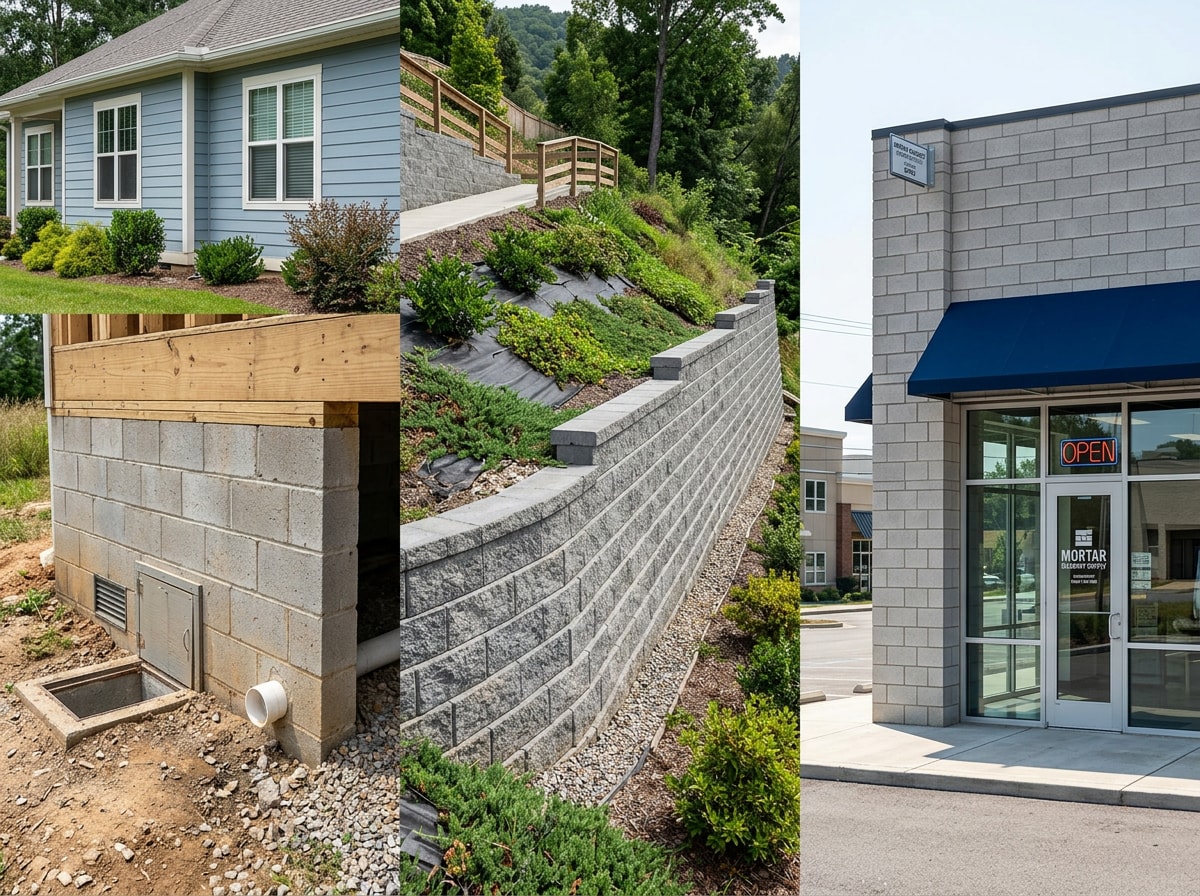
Common Applications of CMU Blocks
CMU applications span both residential and commercial construction throughout the Graham area:
- Foundation walls and crawlspace stem walls
- Retaining wall systems
- Load-bearing exterior walls
- Interior partition walls
- Outdoor structures like property walls or utility buildings
In commercial construction, CMU is a go-to choice for storefronts, warehouses, and multi-unit buildings where fire resistance and sound separation between units matter. Residential projects lean on it for crawlspace foundations, garden walls, and detached garages.
For a closer look at how CMU compares across a similar Piedmont market, our concrete masonry units guide for Chapel Hill, NC covers regional pricing and code nuances worth reading alongside this one.
2026 CMU Cost Snapshot
Pricing moves with material and fuel costs, but based on current retail and supplier data, here's a realistic range for standard gray block in 2026:
| Block Type | Typical Cost Per Block |
|---|---|
| Standard 8x8x16 hollow (retail) | $1.50 – $4.00 |
| Split-face or decorative | $3.00 – $8.00 |
| Solid/structural specialty | $3.00 – $6.50 |
| Lightweight 8x8x16 | $2.40 – $3.40 |
Installed wall costs run higher once labor, mortar, and reinforcement are factored in, and that's where a detailed quote matters more than a per-block number. Get a free estimate for an accurate number on your specific wall or foundation scope.
FAQ
What Is the Standard Size of a CMU?
The standard CMU size is nominal 8x8x16 inches, which measures approximately 7 5/8 x 7 5/8 x 15 5/8 inches once the 3/8-inch mortar joint allowance is factored in. This is the most commonly stocked block for standard wall construction.
What's the Difference Between a Cinder Block and a CMU?
True cinder block used coal ash aggregate and is now largely obsolete. Modern "cinder block" sold today is actually a standard CMU made with sand, gravel, or crushed stone aggregate instead.
How Much Does a CMU Block Cost?
CMU block cost typically ranges from about $1.50 to $4.00 per block depending on size, finish, and local supplier pricing. Decorative or structural specialty blocks run higher than standard gray units, and prices shift with fuel and material costs.
How Long Do CMU Walls Last?
A properly built CMU wall can last 50 to 100 years or more with minimal maintenance. Lifespan depends heavily on correct installation, adequate reinforcement, and proper drainage or waterproofing where needed.
Is CMU Cheaper Than Poured Concrete for a Foundation Wall?
It depends on the project. CMU often has a labor advantage on smaller or irregular walls since it doesn't require formwork, while poured concrete can be more economical on long, straight runs where a pump truck and forms are efficient to set up.
Do I Need a Permit for a CMU Retaining or Foundation Wall in Alamance County?
Most load-bearing CMU walls and retaining walls above a certain height require a permit and, often, an engineer's stamp. Check with the Alamance County or City of Graham permitting office before starting, since thresholds vary by wall height and application.
Can CMU Be Used Above Grade on a House in Graham, NC?
Yes. CMU is commonly used for full masonry homes, crawlspace walls, and veneer backup throughout the area. The block width, reinforcement, and finish just need to match the structural and aesthetic requirements of that specific wall.
Planning a foundation, retaining wall, or masonry build in Graham or anywhere in Alamance County? Visit {{SITE_URL}} to see our full range of concrete and foundation services, or get a free estimate and we'll walk the site with you before you order a single block.