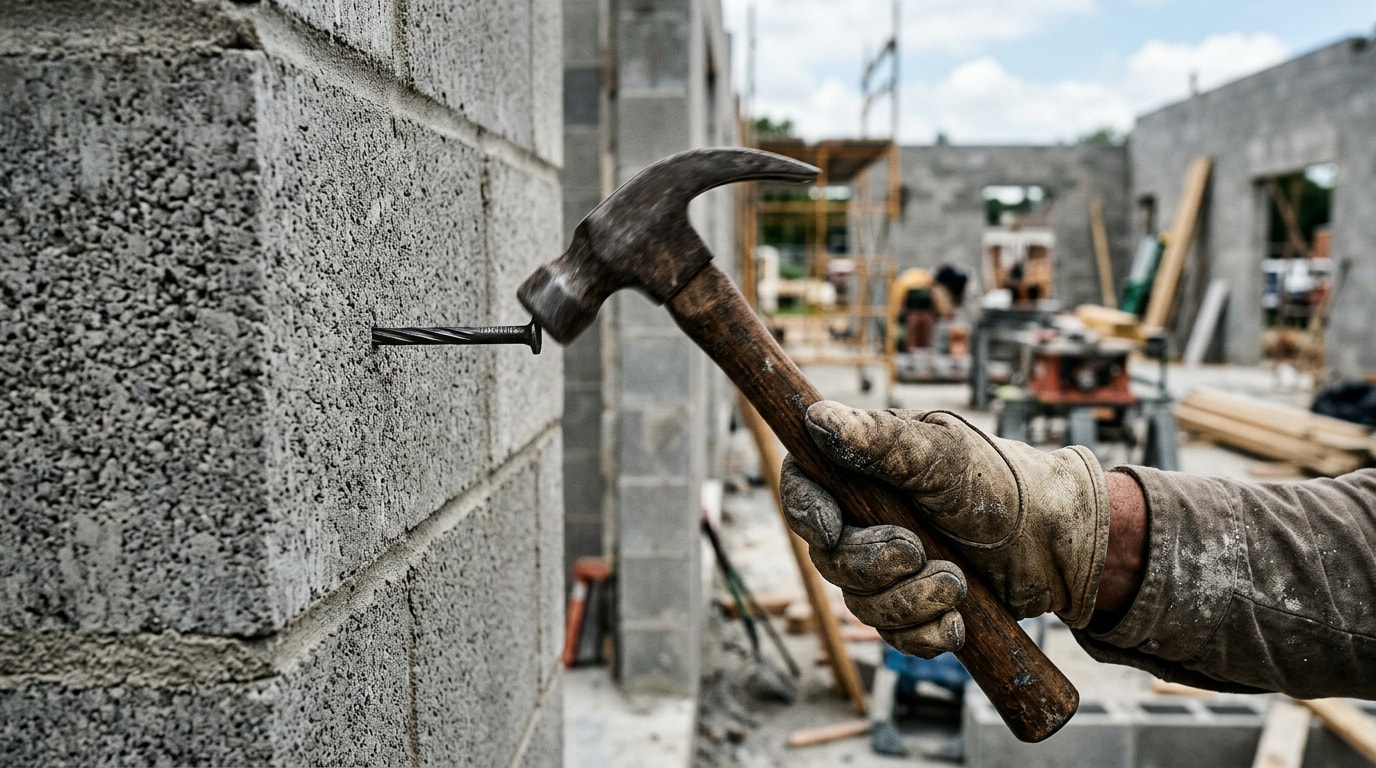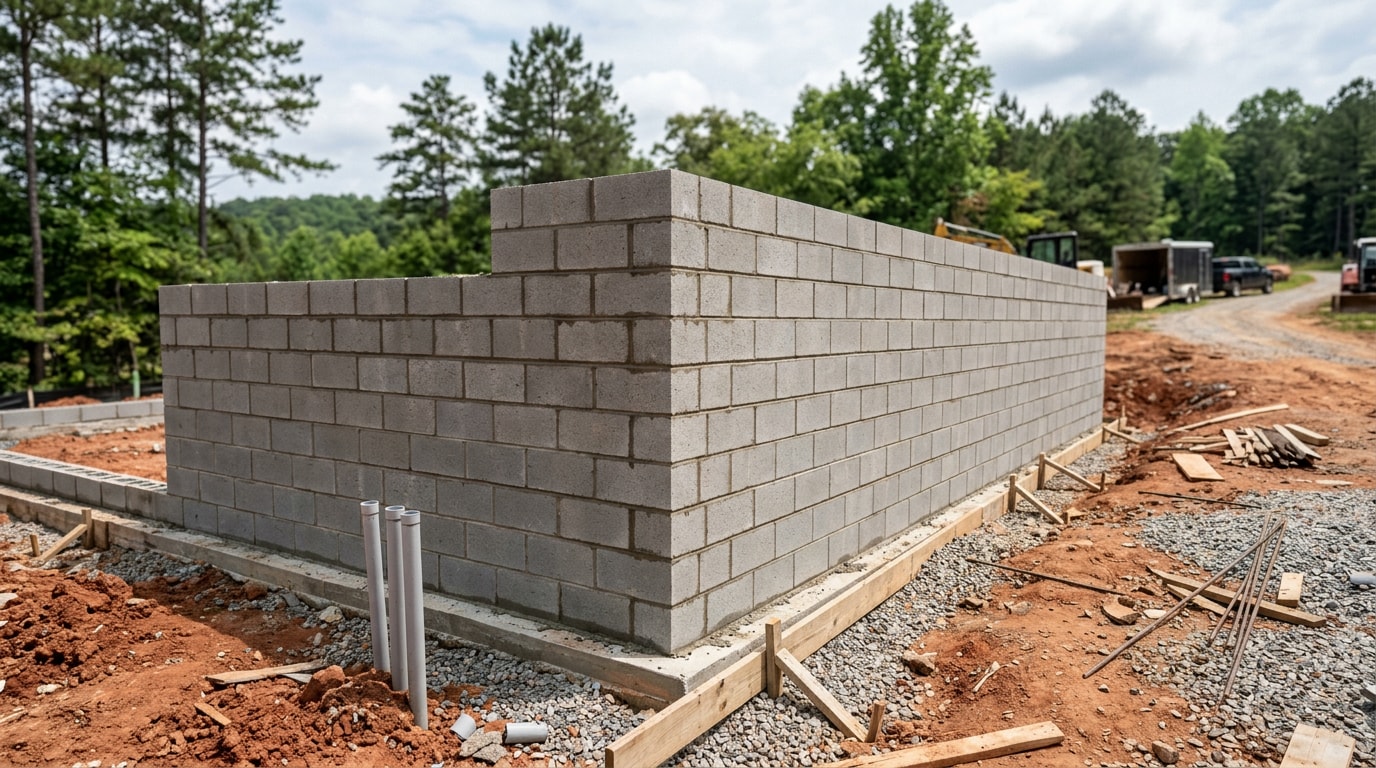
Concrete masonry anchors in Burlington, NC have to deal with three very different base materials, often on the same job: poured concrete foundations, hollow CMU block, and the brick veneer common on Alamance County homes built before 1980. Grab the wrong fastener for the material you're drilling into and you get a stripped hole, a cracked block, or a shelf that pulls loose within months. This guide breaks down which anchor holds in which material, with load ranges and a sizing checklist built from real jobsite calls.
What Is a Masonry Anchor (and Why It Matters Locally)
A masonry anchor is any fastener built to attach objects to concrete, brick, concrete block (CMU), stone, or grout-filled block. Unlike a wood screw, it doesn't thread into fiber. It holds through mechanical expansion, friction, adhesive bonding, or some combination of the three.
Ordinary screws fail in these materials for predictable reasons. Brick is brittle and often hollow in sections. Concrete is dense enough to resist penetration without the right bit. Each substrate needs its own anchoring approach, which is exactly why there isn't a single "universal" masonry fastener.
This matters on the ground in Burlington, NC. On a recent handrail install near downtown, our crew hit solid brick veneer on the top course and hollow CMU block underneath on the same wall, two feet apart. Each required a different anchor to hold rated load. Knowing the difference between a CMU block and a solid concrete unit before you drill saves a trip back to the hardware store.
Concrete Masonry Anchors in Burlington, NC: Types & Strength Reference Chart
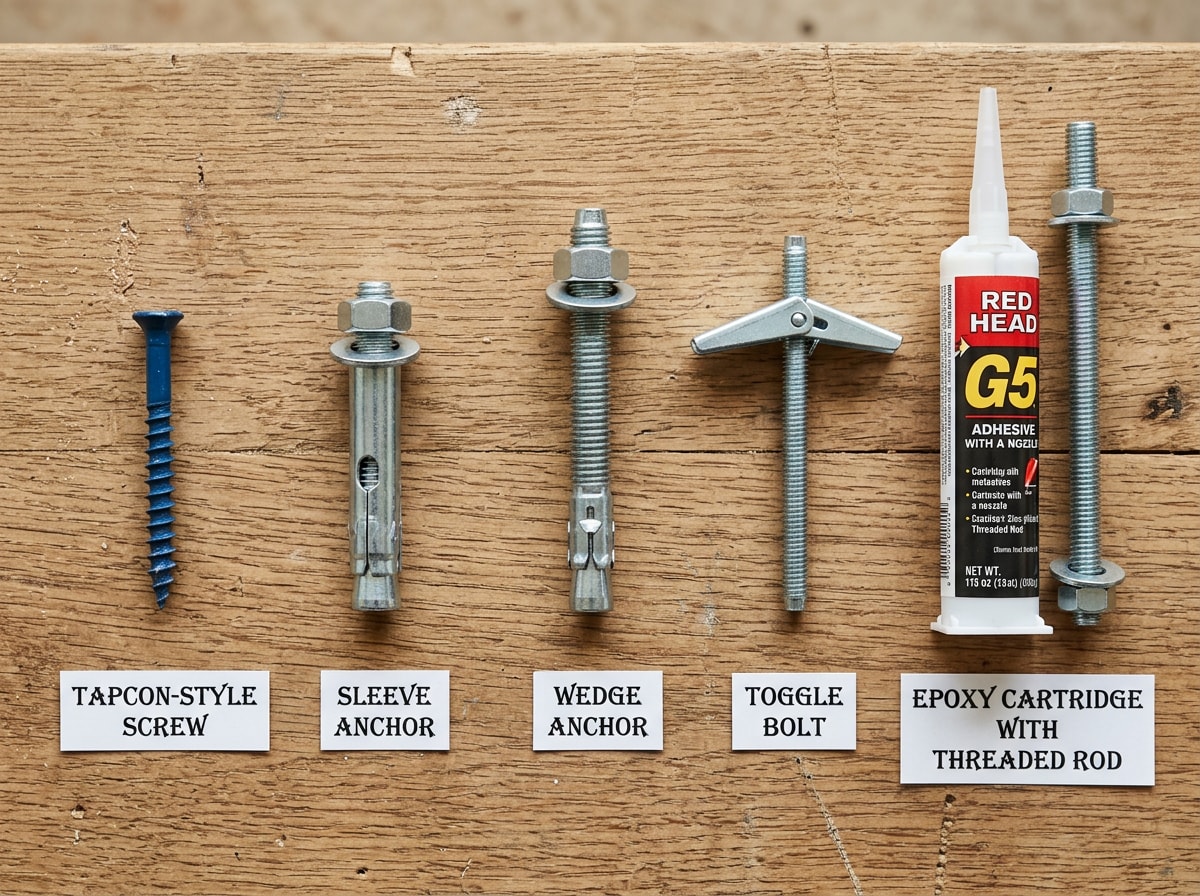
The table below lines up the five most common anchor types by base material, typical load range, and removability, so you can compare options at a glance instead of reading five separate product pages.
| Anchor Type | Best Base Material | Typical Load Range | Removable? |
|---|---|---|---|
| Masonry screw (Tapcon-style) | Solid concrete, brick | 150–500 lbs | Yes |
| Sleeve anchor | Solid concrete, brick, stone | 250–1,200 lbs | No |
| Wedge anchor | Solid concrete only | Up to 2,000+ lbs | No |
| Toggle bolt | Hollow CMU block | 50–250 lbs | Yes |
| Epoxy (adhesive) anchor | Concrete, solid masonry | 1,500+ lbs | No |
These figures reflect published manufacturer ultimate-load data reduced by a standard safety margin, not marketing numbers. Actual capacity always depends on embedment depth, concrete strength, and edge distance, so check the specific anchor's load table before specifying it for anything structural.
Concrete masonry units themselves come in three weight classes under the industry specification that governs block manufacturing. This specification covers dry-cast hollow and solid concrete masonry units machine-made from hydraulic cement, water, and mineral aggregates, with three classes: Normal Weight, Medium Weight, and Lightweight. That classification affects how much an anchor can realistically hold in a given block, since a lightweight CMU face shell behaves differently than a solid normal-weight unit. Full details are in ASTM's C90 standard for loadbearing concrete masonry units.
Masonry Screws (Tapcon)
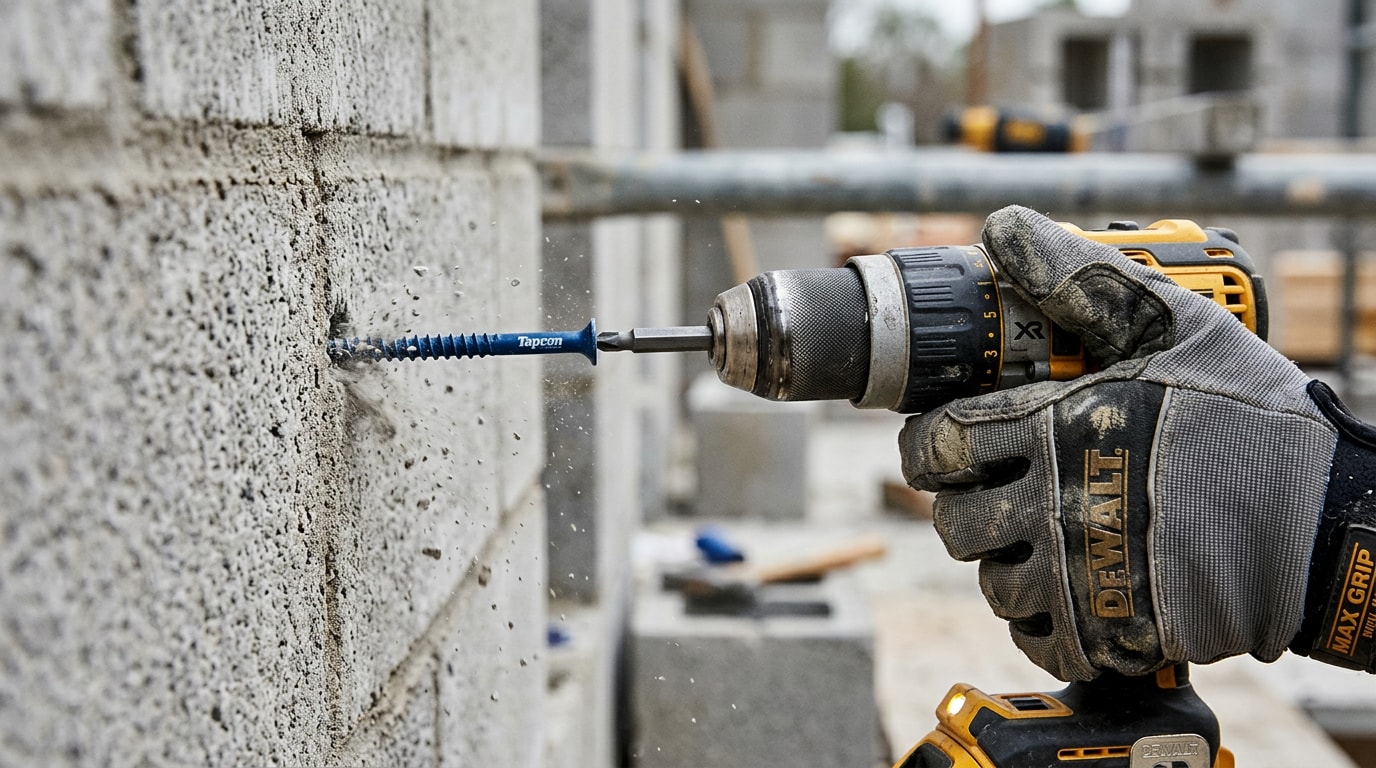
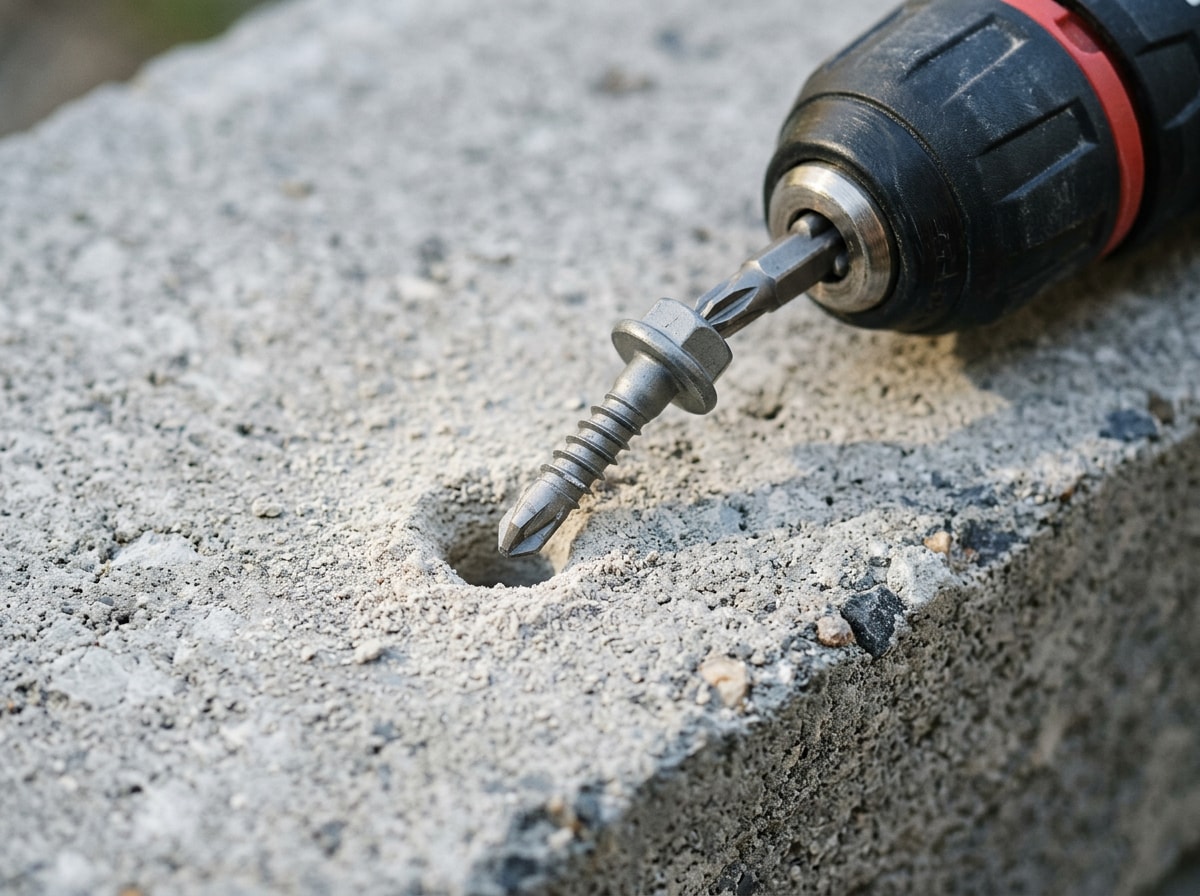
Tapcon-style screws are the most forgiving entry point for DIYers and contractors alike. They're removable and re-insertable, install with a standard hammer drill, and don't require a separate anchor body. They carry lower load capacity than wedge or sleeve anchors and shouldn't go into hollow CMU cores.
Installation is straightforward:
- Drill a pilot hole sized exactly to the manufacturer's bit chart.
- Clear the dust from the hole completely.
- Drive the screw directly in with a driver, no sleeve needed.
Bit sizing is where most installs go wrong. A 3/16-inch Tapcon needs a 5/32-inch bit and a 1/4-inch Tapcon needs a 3/16-inch bit, always undersized versus the screw since Tapcons cut their own threads. Use the wrong diameter and the screw either spins freely or shears off before it seats. For reference, manufacturer technical data lists the minimum and maximum embedment for standard Tapcon screws, which you can check directly in ITW Red Head's Tapcon technical data sheet.
Sleeve Anchors
A sleeve anchor pairs a threaded bolt with an expansion sleeve that grips the hole's walls as the nut is tightened, making it a reliable choice for solid concrete, brick, and natural stone. It is not rated for hollow block, since there's nothing solid for the sleeve to press against.
Common uses include anchoring handrails to walls or floors, mounting brackets and shelving, and fastening signs to exterior masonry. It offers more holding strength than a masonry screw without the longer cure wait of an adhesive system.
Wedge Anchors
Wedge anchors deliver the highest load capacity of any mechanical masonry anchor, which is why they show up on structural brackets, heavy equipment mounts, and ledger connections. The expanding wedge clip at the tip bites into the sides of the drilled hole as the nut is torqued down.
That strength comes with a limit: wedge anchors are rated for solid concrete only, not hollow block or brick. Manufacturer load tables, like the published specs for Simpson Strong-Tie's Strong-Bolt 2 wedge anchor, typically build in a safety factor of 4 on top of ultimate load, and require a minimum concrete thickness around 1.5 times the embedment depth. Treat wedge anchors as a heavy-duty solution for permanent connections, not a general-purpose fastener. If the connection ties into a foundation element, loop in a foundation contractor before you drill.
Toggle Bolts for Hollow Block
Hollow CMU block has nothing solid behind the drilled hole for an expansion mechanism to press against, so mechanical anchors like wedge or sleeve anchors simply spin or pull through. A toggle bolt solves this by opening spring-loaded wings on the far side of the block cavity, spreading the load across the interior face instead.
This makes the toggle bolt the standard choice for hollow block and a dependable option anywhere the wall core is open rather than grout-filled.
Epoxy Anchors
Epoxy anchors use a two-part adhesive injected into a pre-drilled hole. A threaded rod or piece of rebar is set into the wet epoxy, and once cured, the bond chemically fuses rod to masonry, often exceeding the strength of the base material itself.
The tradeoff is time: an epoxy anchor isn't load-ready the moment it's installed. Cure times vary by temperature and product, so the connection needs to sit before any weight goes on it. For code-sensitive structural work, the applicable acceptance criteria covers adhesive anchors in masonry that's assumed to stay uncracked for the anchor's service life and masonry that may crack over time. Installers reference ICC-ES AC58 for adhesive anchors in masonry elements to confirm a chosen system meets the required bond strength for the application. This is the anchor type we reach for on concrete footing tie-ins and other permanent structural connections.
How to Choose the Right Masonry Anchor
Start with embedment depth. For standard Tapcon-style screws, manufacturer specs set a 1-inch minimum and a 1¾-inch maximum embedment into concrete; driving deeper risks shearing the head off. Other anchor types have their own published minimums, so check the specific product's load table rather than guessing.
Next, avoid drilling near mortar joints. Mortar is weaker than the brick or concrete units around it, so an anchor seated mostly in mortar won't hold anywhere near its rated capacity.
From there, the decision comes down to base material and use case:
- Solid poured concrete: Tapcon for light duty, sleeve or wedge anchors for anything heavier.
- Hollow CMU: Toggle bolts or specialty sleeve anchors rated specifically for block.
- Brick veneer: Masonry screws or sleeve anchors sized conservatively, since brick is more brittle than poured concrete.
- Structural or permanent connections (ledger boards, equipment mounts): Epoxy anchor, worth the extra cure time.
- Anything removable: Masonry screw or toggle bolt.
Masonry Anchor Product Details & Specifications
A usable spec sheet for any masonry anchor should list material and finish (zinc-plated steel, stainless steel, or coated for exterior use), diameter, length, drive type, and the base materials it's rated for. Pack counts matter too, especially for job-site quantities versus single-repair purchases.
Before buying, double-check the listed anchor sizes against your actual wall thickness and fixture hole diameter. A mismatch here is one of the most common return reasons at the hardware counter.
If the connection is load-bearing or tied to a structural repair, it's worth having a professional spec it instead of guessing from a chart. Get a free estimate from our crew before you commit to a fastener on anything permanent.
FAQ
What is the strongest masonry anchor?
Epoxy anchors provide the highest load capacity of any masonry anchoring system, since the cured adhesive bonds chemically to both the rod and the surrounding masonry.
Can I use screw anchors in concrete?
Yes. Tapcon-style masonry screws work well in solid concrete, provided you drill the correct pilot hole diameter first and avoid hollow block applications.
Do you need to pre-drill for anchor bolts in concrete?
Yes, pre-drilling is required for nearly every masonry anchor type. These fasteners rely on a precisely sized hole to create the expansion, friction, or adhesive bond that generates holding strength.
Are masonry anchors different than drywall anchors?
Yes. Masonry anchors are built for solid materials like concrete, brick, or stone, while drywall or plaster walls call for toggle bolts, molly bolts, or standard drywall anchors instead.
How much weight can a concrete anchor hold?
It depends on the anchor type, diameter, embedment depth, and the concrete's strength. A single 1/4-inch masonry screw might hold a couple hundred pounds, while a 5/8-inch wedge anchor can rate well over 1,000 pounds. Always check the manufacturer's published load table for the exact anchor and depth you're using.
What's the difference between a sleeve anchor and a wedge anchor?
Both expand mechanically inside the hole, but a wedge anchor's clip bites directly into the concrete for higher load capacity, while a sleeve anchor grips through friction and works in a wider range of materials, including brick and stone, at a lower rated load.
How do you use masonry anchors?
Drill a pilot hole at the correct diameter, clear out the dust, insert the anchor, then tighten or set it per the manufacturer's spec.
Still unsure which fastener fits your project, or dealing with a repair that goes beyond a simple anchor swap? The team at Boswell Brothers of NC handles concrete, masonry, and foundation work across Alamance County, and we're happy to walk a job site with you before you drill. For a deeper look at local masonry services, see our guide on flatwork concrete in Burlington, NC.