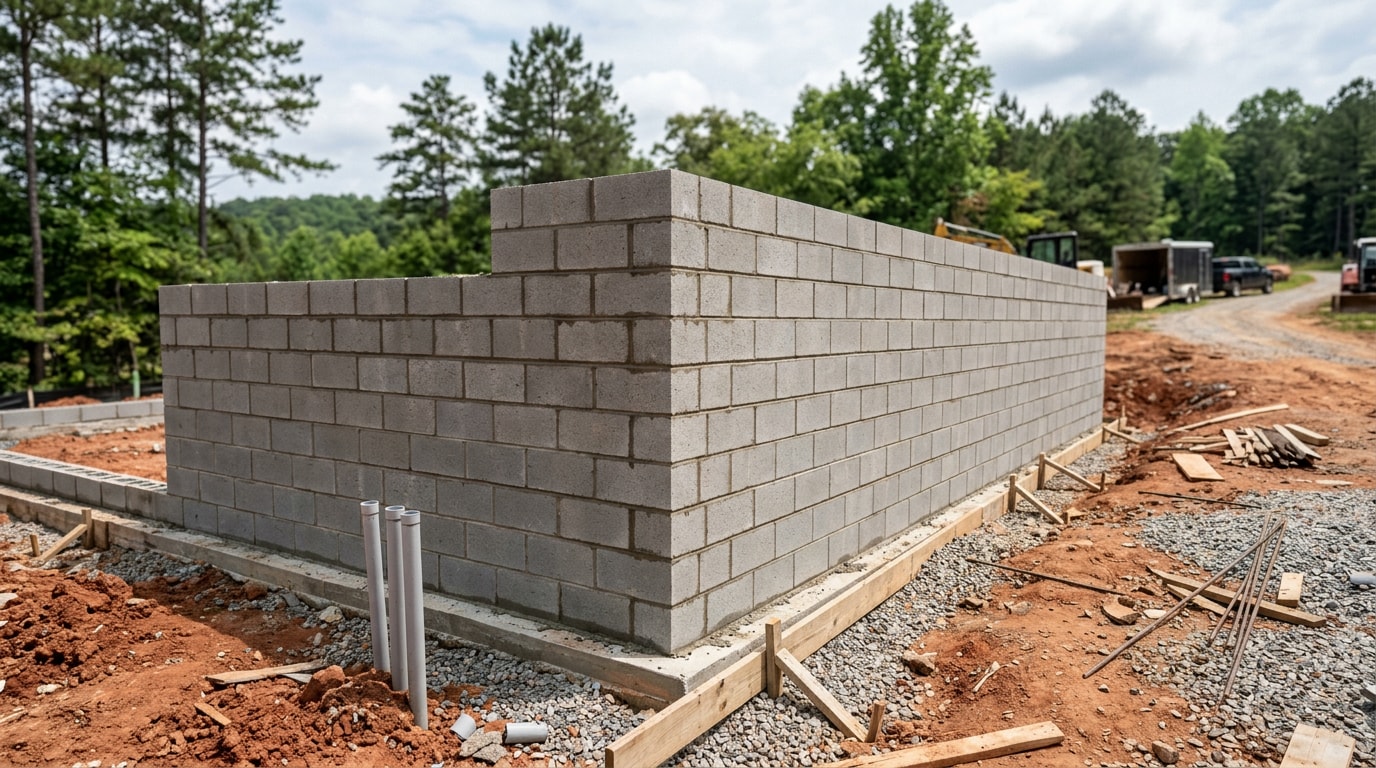
Weighing concrete masonry unit advantages and disadvantages in Graham, NC comes down to one question: will this wall perform in Piedmont humidity, clay soil, and the occasional hard freeze? CMU wins on strength and fire resistance but loses ground on insulation and installation labor. Here's the straight breakdown, plus where it actually makes sense on a local job site.
This guide is maintained by the field team at Boswell Brothers, a concrete and masonry contractor working foundations, block walls, and flatwork across Graham and the greater Alamance County area. On recent crawlspace and foundation jobs here, we've seen local clay soils and uneven bearing conditions push the material decision toward reinforced block more often than homeowners expect. If you want that judgment applied to your own lot, contact us for a free estimate.
What Is a Concrete Masonry Unit?
A concrete masonry unit (CMU) is a precast block made from portland cement, water, and aggregate, cast into a standardized shape and cured before it ever reaches the job site.
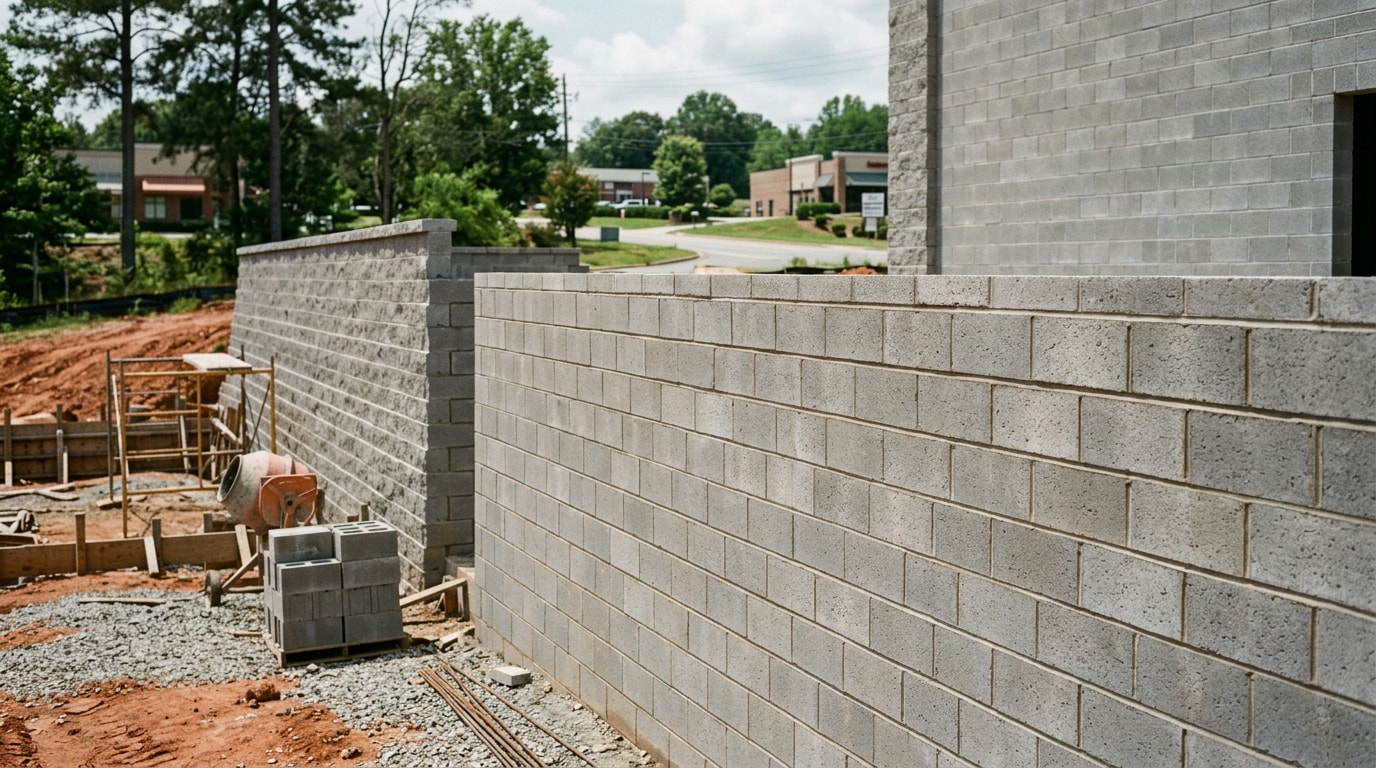
Often called concrete block, CMUs come in hollow or solid cores. The 8x8x16-inch unit is the industry standard for both load-bearing and non-load-bearing walls.

Advantages of Concrete Masonry Units
CMU's reputation is built on strength and fire performance, and both hold up under scrutiny.
- High compressive strength. CMU carries structural loads well, which is why it's the default choice for foundation and load-bearing walls.
- Strong fire resistance. Depending on aggregate type and wall thickness, concrete masonry assemblies can achieve fire-resistance ratings ranging from one to four hours, according to fire resistance testing data published by the Concrete Masonry & Hardscapes Association.
- Durability against pests and impact. Block resists termites, rot, and storm debris better than untreated wood framing.
- Predictable material cost at scale. Because CMU is mass-produced to standard sizes, pricing stays more consistent project to project than custom-milled materials.
- Design flexibility. Block can be stacked, painted, split-faced, or veneered with brick or stone to match almost any architectural style.
Disadvantages of Concrete Masonry Units
The drawbacks are just as real, and they matter more in a climate like Graham's.
Weak insulation value on its own. A standard 8-inch hollow CMU wall typically tests below R-2 unfilled. That's far short of the wall insulation levels referenced in federal energy-efficiency guidance, which point toward much higher R-values for climate zones like North Carolina's before a wall meets modern code expectations, per the Department of Energy's insulation and air-sealing guidance.
That gap means cores usually need to be filled, or exterior insulation added, to satisfy North Carolina's energy code for conditioned walls.
Moisture sensitivity without sealing. Graham's humid summers and freeze-thaw winters can drive water into unsealed block over time, leading to efflorescence (that white, chalky mineral bloom) or interior dampness in unfinished basements.
Heavy, labor-intensive installation. A single 8x8x16 block weighs 30 to 40 pounds. Building a wall from hundreds of them requires skilled masons and more install time than comparable framed walls.
Limited raw aesthetics. Unfinished block reads industrial. Most residential applications budget for paint, stucco, or a veneer finish.
| Material | Weight | Unfilled Insulation Value | Labor Intensity |
|---|---|---|---|
| CMU | Heavy | Low (under R-2) | High |
| Wood Frame | Light | Moderate (with batt insulation) | Moderate |
| ICF | Moderate | High (R-20+) | Moderate to High |
Where CMU Works Best in Graham, NC
Concrete masonry shows up most in foundation walls, basement walls, retaining walls, and fire-rated partitions, where compressive strength and fire performance matter more than insulation.
Locally, that translates to:
- Residential foundation walls and crawlspace walls, especially on lots with uneven or rocky bearing soil
- Garage and outbuilding load-bearing walls
- Retaining walls on the sloped lots common around Alamance County
- Fire-rated separation walls in multi-unit or light commercial buildings
Homeowners planning new footings or a foundation often compare concrete foundation pouring against block before locking in a material, since site conditions (not just budget) often decide the call. Our foundation installation crews can walk a specific lot and tell you which one fits.
Cinder Block vs. CMU: What's the Difference?
"Cinder block" and "CMU" get used interchangeably, but they're not technically the same product.
True cinder blocks used coal-cinder aggregate decades ago. Modern CMUs use concrete aggregate like sand, gravel, or crushed stone instead.
That distinction matters when comparing quotes. Aggregate type affects strength, weight, and price, so a "cinder block" price from an older supplier catalog may not match current CMU specs. For a deeper dive into sizes and specs for this exact market, see our CMU concrete masonry unit guide for Graham, NC.
Is CMU a Sustainable Choice?
CMU can be a genuinely sustainable option. Many producers blend recycled aggregate, such as crushed concrete, into the mix, cutting demand for virgin material.
Concrete and masonry debris is also one of the most commonly recycled construction materials in the U.S., and the EPA notes that brick, concrete and masonry can be recycled on site as fill, subbase material or driveway bedding , which keeps demolition waste out of landfills.
CMU's mass also helps moderate indoor temperature swings through thermal lag, and its long service life reduces how often a wall assembly needs to be replaced at all.
CMU vs. Wood Frame vs. ICF: Quick Comparison
| Factor | CMU | Wood Frame | ICF |
|---|---|---|---|
| Best use | Foundations, retaining walls, fire-rated walls | Above-grade walls, additions | High-efficiency new construction |
| Fire resistance | Excellent | Poor without added protection | Excellent |
| Insulation (as-built) | Low unless filled | Moderate | High |
| Typical labor | Skilled masons, slower install | Faster framing crews | Moderate, specialized forms |
| Moisture handling | Needs sealing in humid climates | Needs vapor barrier detailing | Strong, built-in |
Talk to a Local Concrete and Masonry Contractor
Most homeowners in Graham don't need to pick a side between CMU, wood frame, and ICF in the abstract. They need someone to look at the soil, the grade, the budget, and the use case, then make the call.
Our concrete contractor team and general contractor crews handle both sides of that decision, from poured foundations to block walls to the flatwork that ties it together. If you're in Graham or anywhere in the surrounding Piedmont, visit our homepage to see the full scope of what we build, or go straight to a free estimate.
FAQ
Is CMU cheaper than wood framing for a Graham home?
It depends on the wall. CMU material cost per unit is predictable, but labor runs higher because block installation is slower and requires skilled masons. For above-grade walls, wood framing is often cheaper overall. For foundations and retaining walls, CMU is usually the standard regardless of cost comparison because of its load-bearing and moisture performance.
What is the R-value of a standard CMU wall?
An unfilled 8-inch hollow CMU wall typically tests under R-2. That's well below the wall insulation levels referenced in current federal energy guidance for most U.S. climate zones, so cores are usually filled with insulation or paired with exterior rigid foam to meet code on conditioned space.
Do concrete block walls hold up in the Piedmont's humidity and freeze-thaw swings?
Yes, if they're properly sealed and detailed. Unsealed block in this climate can take on moisture over time, leading to efflorescence or dampness in a basement. A parged or sealed exterior finish and proper drainage at the footing solve most of this.
Is masonry the same as concrete?
Not exactly. Concrete is a material. Masonry is a construction method using units like block, brick, or stone bound together with mortar. CMU sits at the intersection, since it's a concrete product installed using masonry techniques.
What are the downsides of AAC block compared to standard CMU?
AAC (autoclaved aerated concrete) block has lower compressive strength than standard CMU, absorbs moisture more readily, and needs specialized fasteners. Standard CMU generally holds up better for load-bearing residential applications.
Is a block foundation better than a slab in Graham, NC?
Block foundations cost more and take longer to build than a slab, but they handle moisture and grading challenges better on sloped or uneven lots, which is a real factor on many Alamance County sites.
<br>
{ "hero": { "prompt": "Photoreal trade photo, no people, a newly built concrete masonry unit (CMU) block foundation wall on a residential construction site in North Carolina, hollow-core gray concrete blocks stacked with visible mortar joints, partially backfilled with red clay soil, daylight, slightly overcast sky, wide angle, realistic construction photography", "alt": "Concrete masonry unit foundation wall under construction on a residential lot" }, "inline": [ { "id": "inline-1", "prompt": "Photoreal close-up trade photo, no people, a single standard gray hollow concrete masonry unit (CMU) block resting on a pallet of similar blocks at a job site, visible hollow cores, natural daylight, shallow depth of field, realistic material photography", "alt": "Standard hollow concrete masonry unit block used in Graham, NC construction" } ] }